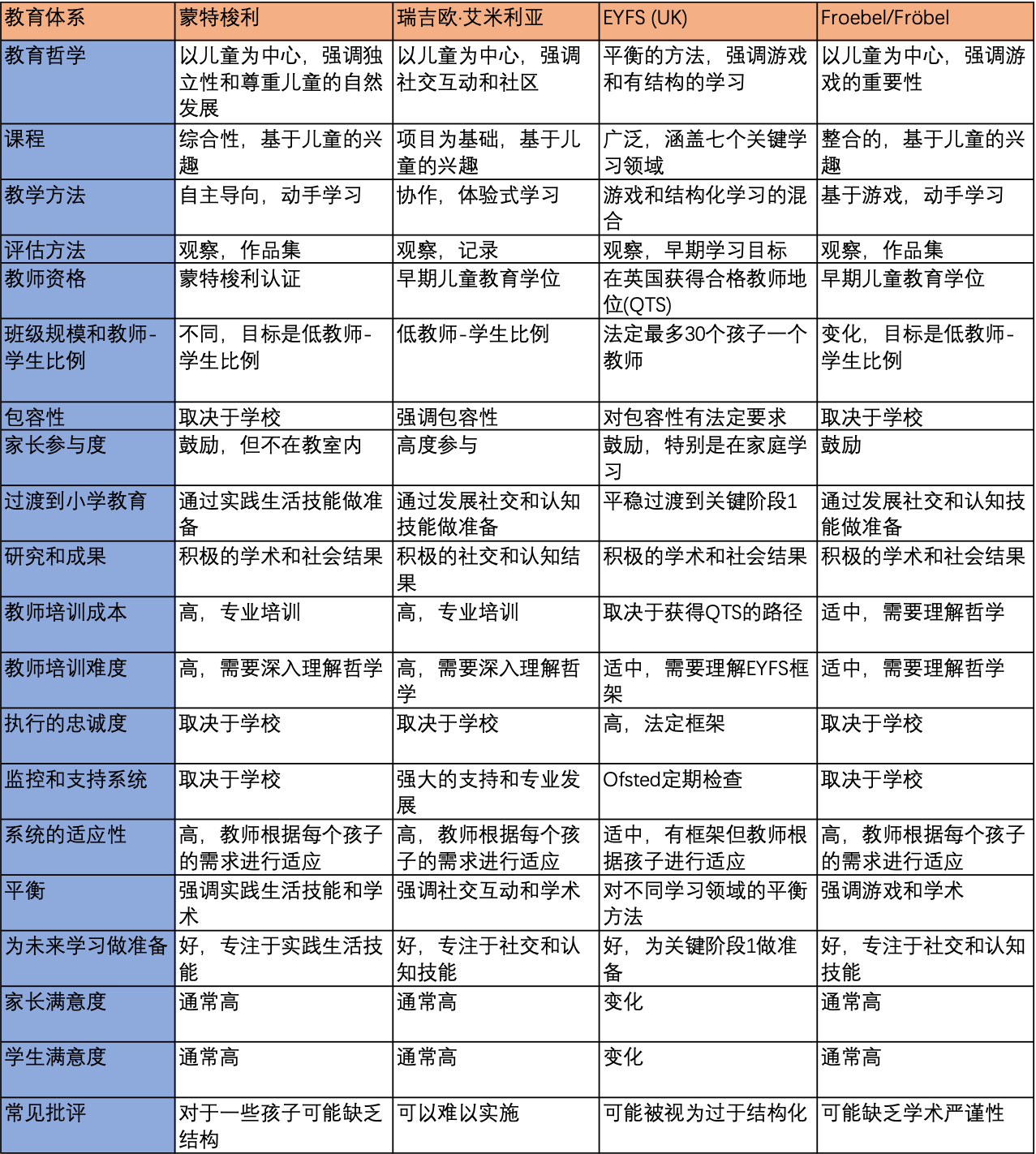
4种主要的幼儿教育体系的20个维度的对比
| Educational System | Educational Philosophy | Curriculum | Teaching Methods | Assessment Methods | Teacher Qualifications | Class Size and Teacher-Student Ratio | Inclusion | Parental Involvement | Transition to Primary Education | Research and Outcomes | Cost of Teacher Training | Difficulty of Teacher Training | Fidelity of Implementation | Monitoring and Support Systems | Adaptability of the System | Balance | Preparation for Future Learning | Parent Satisfaction | Student Satisfaction | Common Criticisms |
|---|---|---|---|---|---|---|---|---|---|---|---|---|---|---|---|---|---|---|---|---|
| Montessori | Child-centered, emphasizes independence and respect for the child’s natural development | Integrated, based on child’s interests | Self-directed, hands-on learning | Observation, portfolio | Montessori certification | Varies, aim for low student-teacher ratio | Depends on the school | Encouraged, but not in the classroom | Prepared through practical life skills | Positive academic and social outcomes | High, specialized training | High, requires deep understanding of philosophy | Depends on the school | Depends on the school | High, teachers adapt to each child’s needs | Emphasizes practical life skills and academics | Good, focus on practical life skills | Generally high | Generally high | May lack structure for some children |
| Reggio Emilia | Child-centered, emphasizes social interaction and community | Project-based, based on child’s interests | Collaborative, experiential learning | Observation, documentation | Early childhood education degree | Low student-teacher ratio | Strong emphasis on inclusion | High level of involvement | Prepared through development of social and cognitive skills | Positive social and cognitive outcomes | High, specialized training | High, requires deep understanding of philosophy | Depends on the school | Strong support and professional development | High, teachers adapt to each child’s needs | Emphasizes social interaction and academics | Good, focus on social and cognitive skills | Generally high | Generally high | Can be difficult to implement |
| EYFS (UK) | Balanced approach, emphasizes play and structured learning | Broad, covers seven key areas of learning | Mix of play-based and structured learning | Observation, Early Learning Goals | Qualified Teacher Status (QTS) in UK | Legal maximum of 30 children per teacher | Legal requirement for inclusion | Encouraged, particularly in home learning | Smooth transition to Key Stage 1 | Positive academic and social outcomes | Depends on the route to QTS | Moderate, requires understanding of EYFS framework | High, statutory framework | Regular inspections by Ofsted | Moderate, framework but teachers adapt to children | Balanced approach to different areas of learning | Good, prepares for Key Stage 1 | Varies | Varies | Can be seen as too structured |
| Froebel/Fröbel | Child-centered, emphasizes importance of play | Integrated, based on child’s interests | Play-based, hands-on learning | Observation, portfolio | Early childhood education degree | Varies, aim for low student-teacher ratio | Depends on the school | Encouraged | Prepared through development of social and cognitive skills | Positive academic and social outcomes | Moderate, requires understanding of philosophy | Moderate, requires understanding of philosophy | Depends on the school | Depends on the school | High, teachers adapt to each child’s needs | Emphasizes play and academics | Good, focus on social and cognitive skills | Generally high | Generally high | May lack academic rigor |
中文翻译,有些术语的翻译有问题,比如,“教师-学生比例”应当为“学生-教师比例”
| 教育体系 | 教育哲学 | 课程 | 教学方法 | 评估方法 | 教师资格 | 班级规模和教师-学生比例 | 包容性 | 家长参与度 | 过渡到小学教育 | 研究和成果 | 教师培训成本 | 教师培训难度 | 执行的忠诚度 | 监控和支持系统 | 系统的适应性 | 平衡 | 为未来学习做准备 | 家长满意度 | 学生满意度 | 常见批评 |
|---|---|---|---|---|---|---|---|---|---|---|---|---|---|---|---|---|---|---|---|---|
| 蒙特梭利 | 以儿童为中心,强调独立性和尊重儿童的自然发展 | 综合性,基于儿童的兴趣 | 自主导向,动手学习 | 观察,作品集 | 蒙特梭利认证 | 不同,目标是低教师-学生比例 | 取决于学校 | 鼓励,但不在教室内 | 通过实践生活技能做准备 | 积极的学术和社会结果 | 高,专业培训 | 高,需要深入理解哲学 | 取决于学校 | 取决于学校 | 高,教师根据每个孩子的需求进行适应 | 强调实践生活技能和学术 | 好,专注于实践生活技能 | 通常高 | 通常高 | 对于一些孩子可能缺乏结构 |
| 瑞吉欧·艾米利亚 | 以儿童为中心,强调社交互动和社区 | 项目为基础,基于儿童的兴趣 | 协作,体验式学习 | 观察,记录 | 早期儿童教育学位 | 低教师-学生比例 | 强调包容性 | 高度参与 | 通过发展社交和认知技能做准备 | 积极的社交和认知结果 | 高,专业培训 | 高,需要深入理解哲学 | 取决于学校 | 强大的支持和专业发展 | 高,教师根据每个孩子的需求进行适应 | 强调社交互动和学术 | 好,专注于社交和认知技能 | 通常高 | 通常高 | 可以难以实施 |
| EYFS (UK) | 平衡的方法,强调游戏和有结构的学习 | 广泛,涵盖七个关键学习领域 | 游戏和结构化学习的混合 | 观察,早期学习目标 | 在英国获得合格教师地位(QTS) | 法定最多30个孩子一个教师 | 对包容性有法定要求 | 鼓励,特别是在家庭学习 | 平稳过渡到关键阶段1 | 积极的学术和社会结果 | 取决于获得QTS的路径 | 适中,需要理解EYFS框架 | 高,法定框架 | Ofsted定期检查 | 适中,有框架但教师根据孩子进行适应 | 对不同学习领域的平衡方法 | 好,为关键阶段1做准备 | 变化 | 变化 | 可能被视为过于结构化 |
| Froebel/Fröbel | 以儿童为中心,强调游戏的重要性 | 整合的,基于儿童的兴趣 | 基于游戏,动手学习 | 观察,作品集 | 早期儿童教育学位 | 变化,目标是低教师-学生比例 | 取决于学校 | 鼓励 | 通过发展社交和认知技能做准备 | 积极的学术和社会结果 | 适中,需要理解哲学 | 适中,需要理解哲学 | 取决于学校 | 取决于学校 | 高,教师根据每个孩子的需求进行适应 | 强调游戏和学术 | 好,专注于社交和认知技能 | 通常高 | 通常高 | 可能缺乏学术严谨性 |